Project NOAH Files
The Passage (Justin Cronin Edition)The Project NOAH Files are the surviving paper record through which Peter learns that the history of his world began not with an absent Army’s return, but with its own role in the disaster. Retrieved from the burning underground Chalet alongside Amy’s backpack, the files connect the Twelve, Amy, Bradford Wolgast, and Project NOAH, turning fragmentary records into a revelation about the Colony’s origins.
Recovery and reading
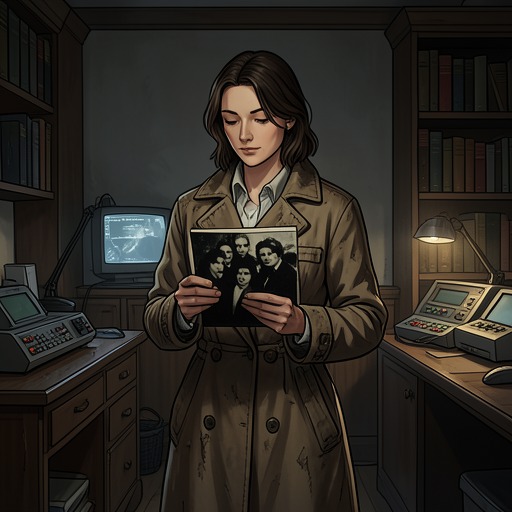
The documents are yellowed manila folders that had endured for many years and still carried a faint smell of smoke. A doctor retrieved them as fires moved through the Chalet’s underground levels, judging that someone ought to know what they contained. Their survival is precarious and material: an archive nearly lost to fire becomes the evidence that lets Peter reconstruct a history his community has not known.
Sister Lacey places the first folder before Peter and tells him that it is time to learn how this world was made. He reads through the files late into the night while Amy sleeps nearby and Lacey explains information he cannot interpret alone. The folders are thick and include photographs as well as documents; together, they give Peter a partial account of a world he has never seen. The discovery is therefore not a single document’s revelation but an act of reconstruction, dependent on the records’ survival and Lacey’s knowledge.
The Twelve and Babcock
Among the files are records identifying the original subjects. Peter encounters accounts and photographs of men taken from prisons across several states, their institutional identification boards marking the carceral systems from which they came. The records frame the subjects not as mysterious figures detached from history, but as men selected from death row and transferred into a government program.
The first subject is Giles J. Babcock, born in Desert Wells, Nevada, and sentenced to death for capital murder in Nye County in 2013. The place-name immediately connects the file to the history Peter has been piecing together; after reading it, he recalls the pattern expressed in the phrase, “They always go home.” Babcock’s record gives the remembered connection documentary weight: one of the Twelve originated in a place that remains significant to the story’s present.
The files also identify Anthony L. Carter as Subject 12, born in Baytown, Texas, and sentenced to death for capital murder in Harris County. Read beside Babcock’s entry and the other prison records, Carter’s designation makes clear that the project’s subjects were numbered and documented as a group. The files expose an institutional history behind the viral threat, even as Peter can only piece together part of what the records mean.
Amy and Wolgast in the record
Amy’s file is thinner than the others. Labeled “SUBJECT 13, AMY NLN,” it locates her at the Convent of the Sisters of Mercy in Memphis and lists physical and medical information, including figures Peter recognizes as resembling data Michael found on the chip in her neck. A photograph shows Amy as a young child sitting on a wooden chair. Peter recognizes her eyes and must reconcile the image of the child in the file with the Amy he knows. The document establishes that Amy, like the numbered subjects before her, was recorded by the project, while leaving the larger significance of her status to be understood from the surrounding evidence.
Bradford Wolgast’s file has no photograph; a rusty mark shows where one was once attached. Peter nevertheless understands from the records and Lacey’s account that Wolgast brought the Twelve to the compound, and Amy as well. The file says Wolgast had been married and had a daughter, Eva, who was deceased. Peter wonders whether that loss helps explain Wolgast’s decision to help Amy, but the thought remains his inference rather than a fact established by the document.
Military purpose and historical consequence
The last file contains a report from Cole to Colonel Sykes concerning Dr. Jonas Lear’s work and Project NOAH. Beside it is a later order, dated five years afterward, directing the transfer of twelve human test subjects from Telluride, Colorado, to White Sands, New Mexico, for operational combat testing. The juxtaposition links the project’s research to a military purpose: the subjects were not merely studied but moved under an order that explicitly names combat testing.
Peter takes time to assemble the implications, and his understanding remains incomplete. But the documents are enough to reverse the story he has inherited: the Colony had waited for the Army to return, while the Army’s own program helped create the conditions of the present. The files matter not because they answer every question, but because their surviving names, numbers, locations, and transfer order transform an old expectation into a reckoning with the institution behind the catastrophe.